
Kundli Basics: Reading Your Janma Kundli in 5 Minutes
Understanding Lagna, Moon Sign, and the 9 Grahas for Beginners
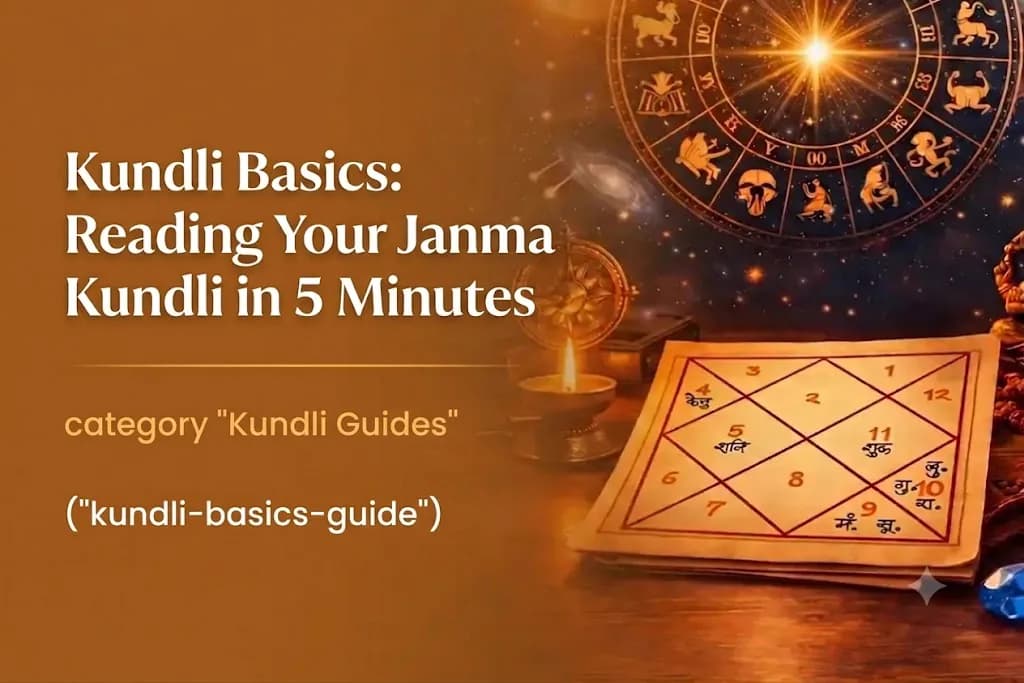
What is a Janma Kundli (Birth Chart)?
In Vedic astrology (Jyotish Shastra), a Janma Kundli is a celestial snapshot of the cosmos at the precise moment and geographic location of your birth. Divided into 12 houses (Bhavas) and representing 12 zodiac signs (Rashis), it maps the planetary energies that influence your life trajectory.
While Western astrology predominantly emphasizes the Sun sign, authentic Vedic astrology places profound emphasis on your Ascendant (Lagna) and Moon Sign (Chandra Rashi). Generate your own chart instantly with the Free Janam Kundli Calculator — your Lagna, Moon sign, Nakshatra and planetary positions appear within seconds.
The 3 Pillars of Kundli Interpretation
1. The Ascendant (Lagna): The zodiac sign rising on the eastern horizon at your birth time. It defines your physical constitution, temperament, and life purpose.
2. Moon Sign (Chandra Rashi): The constellation where the Moon was transiting. Because the Moon governs the subconscious mind and emotions, it reveals mental resilience and instinctual responses, and it is the sign used for your daily Rashifal.
3. The 9 Grahas (Planets): Surya, Chandra, Mangal, Budh, Guru, Shukra, Shani, Rahu, and Ketu. Each planet activates specific houses and life areas such as career, marriage, and wealth. The Sun rules vitality and authority; the Moon rules mind; Mars rules courage and property; Mercury rules intellect and business; Jupiter rules wisdom, children and wealth; Venus rules love, marriage and comfort; Saturn rules discipline, karma and longevity; while Rahu and Ketu, the lunar nodes, represent karmic desires and detachment.
The 12 Houses (Bhavas) at a Glance
The kundli is a wheel of 12 houses that map the main departments of life: 1st house — self and body; 2nd — wealth, speech and family; 3rd — courage, communication and siblings; 4th — home, mother and peace of mind; 5th — intelligence, children and creativity; 6th — health, service and competition; 7th — marriage and partnerships; 8th — longevity, transformation and hidden matters; 9th — fortune, dharma and higher learning; 10th — career and public standing; 11th — gains and networks; 12th — expenses, foreign lands and moksha.
A simple way to begin reading any kundli is to locate the planet ruling your Lagna (the Lagna Lord) and see which house it sits in — that house becomes a major theme of your life. Then check where the Moon and Saturn sit, because the Moon shows your mind and Saturn shows the area where life teaches you the most discipline.
Dasha Periods: Why Timing Matters As Much As Position
A kundli is a map, but time is the current. The Vimshottari Dasha system divides life into planetary periods ruled by each graha — the Sun 6 years, Moon 10, Mars 7, Rahu 18, Jupiter 16, Saturn 19, Mercury 17, Ketu 7, and Venus 20, totaling 120 years. The Mahadasha under which you are born and the Antardashas that follow determine when the promises in your chart manifest.
A beautifully placed Jupiter in the chart can still underperform during a difficult Rahu Mahadasha; a moderately placed Saturn can deliver outstanding results during a well-supported Saturn period if the native practices consistent effort. This is why experienced astrologers always combine position, strength, and Dasha timing before promising any result. For a detailed map of your current periods, book a consultation with Director Acharya SK Vaksish.
Your First 5-Minute Kundli Reading, Step by Step
Step 1 — Note your Lagna and Moon sign from the chart. These two signs shape your identity and mind.
Step 2 — Find your Lagna Lord and Nakshatra. Your birth Nakshatra (lunar constellation) governs sub-personality and is also the basis of your Vimshottari Dasha starting point.
Step 3 — Spot the strong houses: planets in Kendra (1, 4, 7, 10) or Trikona (1, 5, 9) generally work well for that life department.
Step 4 — Check Saturn: the house Saturn occupies teaches karmic lessons; Saturn in 3rd, 6th, or 11th (upachaya) matures with age; in 8th or 12th it deepens a spiritual or research bent.
Step 5 — Note Rahu and Ketu. Their house axis shows where life pulls you toward new ambition (Rahu) and where you are naturally detached and already gifted (Ketu) — for the full picture, see our Rahu-Ketu transit guide and the free Rahu Ketu Calculator.
Guidance by SK Vaksish
Director at Shri Hariom Foundation, renowned Vedic astrologer and Vastu consultant featured on national television (ABP News, Zee News, India TV, MH1 Shraddha).
Frequently Asked Questions
Can I read my kundli without an astrologer?
Yes — learn Lagna, Moon sign, the 9 planets and 12 houses first, then read house placements and the running Dasha. A [free Kundli](/kundli) gives you the raw chart; interpretation deepens with practice or a professional reading.
Which is more important, Sun sign or Moon sign, in Vedic astrology?
In Vedic astrology the Moon sign and Lagna carry more weight than the Sun sign. Sun sign is a Western convention; Vedic readers use Moon sign for Rashifal and Lagna for life-defining analysis.
What is a good kundli?
No chart is entirely "good" or "bad" — every kundli has strong houses and challenging houses. A chart is favourable when the Lagna Lord, the 9th lord and the 10th lord are well placed and supported by the running Dasha.
Related Astrology & Vastu Guides
Need Personalized Guidance for Your Janma Kundli?
Connect directly with Acharya SK Vaksish for in-depth chart reading, Dasha timelines, and Vedic remedies tailored to your birth chart.